














Headquarters:3rd Floor, Haiguo Jiaye Sci-Tech Park, Haidian District, Beijing, China

We use cookies to enhance your browsing experience and serve personalized content.
Reject ALL
Accept ALL


2025-12-02
The Challenge of Diminishing Reaction Time
At high speeds, the margin for error in perception systems shrinks to near zero. The fundamental challenge is rooted in physics: the faster a drone travels, the greater the distance it covers in a given amount of time. This directly impacts the entire obstacle avoidance workflow.
Data Latency and Processing Delays
Conventional sensors with standard update rates (e.g., 100 Hz) provide a new distance measurement every 10 milliseconds. While sufficient for low-speed operations, this creates a dangerous data gap at high velocities. In the time between sensor readings, a fast-moving drone can travel a significant distance, effectively flying blind. If an obstacle appears during this interval, the flight controller will not receive the data in time to prevent a collision. The system's total reaction time—a sum of detection time, data transmission, processing, and maneuver execution—becomes too long.
The Need for High-Density Data
To ensure safety at speed, a flight controller requires a near-continuous stream of environmental data. It needs to know not just that an object is present, but its precise location updated in real time. A low-frequency sensor provides sporadic updates, creating an incomplete picture of the flight path. For a racing drone, this intermittent data is insufficient for navigating complex courses or avoiding unexpected obstacles.
Addressing the limitations of traditional sensors in high-speed environments requires a paradigm shift in both data acquisition rate and system integration. Ultra-high-frequency LiDAR technology, such as the TFA300 series, fundamentally enhances a platform's ability to perceive and respond to its environment at racing speeds.
The Solution: Ultra-High-Frequency LiDAR
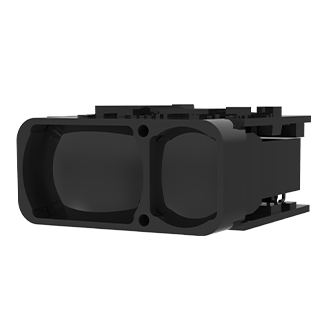
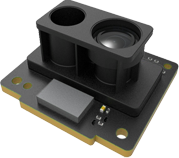
Addressing the limitations of traditional sensors in high-speed environments requires a paradigm shift in both data acquisition rate and system integration. Ultra-high-frequency LiDAR technology, such as the TFA300 series drone range finder, fundamentally enhances a platform's ability to perceive and respond to its environment at racing speeds.
Technical Rationale for High-Frequency Sensing
At extreme velocities, the interval between environmental measurements must be minimized. A standard LiDAR sensor operating at 100 Hz provides updates every 10 milliseconds. For an FPV racing drone traveling at 50 m/s, this translates to half a meter of blind travel between samples. In contrast, a LiDAR system capable of 10,000 Hz delivers a measurement every 0.1 milliseconds, reducing the unsampled distance to approximately 5 millimeters per reading at the same speed. This ultra-high measurement density is essential to detect rapidly appearing obstacles, such as the poles, wires, and infrastructure common on racing courses or urban SAR missions.
Synchronization and Data Flow
The impact of ultra-high-frequency sensors extends beyond sampling rate. When paired with modern flight control hardware and low-latency communication protocols (such as CAN and DroneCAN), the data pipeline—from detection to processing and maneuver execution—is optimized for minimal delay. This rapid exchange enables flight control algorithms to initiate corrective action nearly instantaneously, which is critical in high-dynamic environments where object distances can close in under a second.
Practical Application Scenarios
FPV Racing Drones: In competitive drone racing, drones must navigate complex courses defined by a series of gates, obstacles, and sudden turns at speeds often exceeding 100 km/h. Ultra-high-frequency LiDAR provides dense spatial information, allowing the onboard flight controller to preemptively adjust trajectory, prevent collisions, and maintain velocity through aggressive maneuvers.
Search and Rescue UAVs: SAR drones traversing dense forests or cluttered spaces at elevated speeds benefit from continuous obstacle profiling. High-frequency updates support both low-altitude flight and rapid altitude changes without compromising situational awareness or safety.
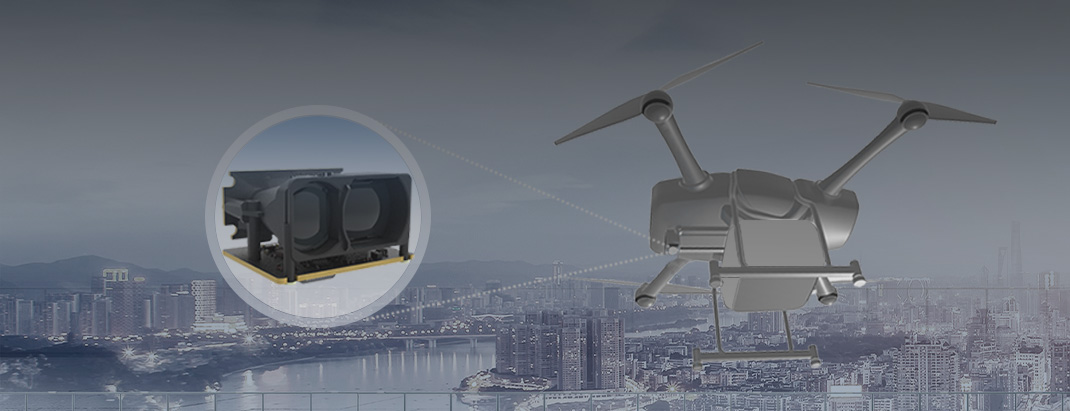
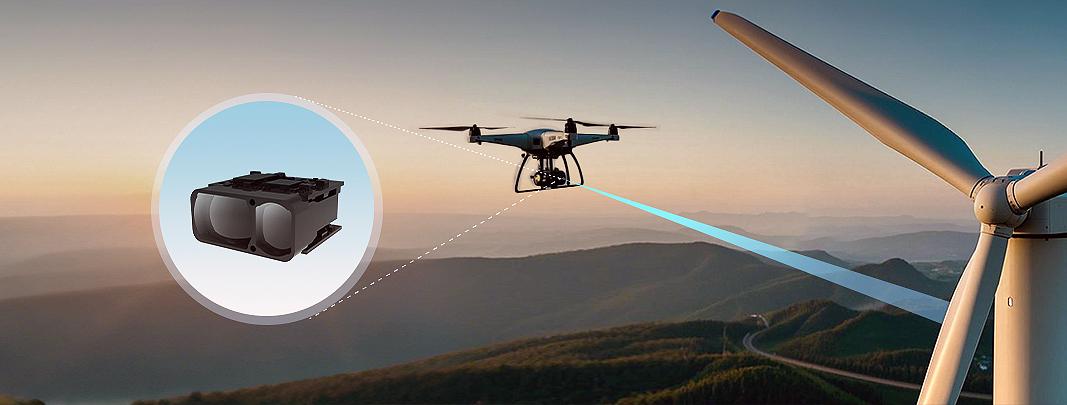
EO/IR Gimbals and Camera Systems: The TFA300 series can be integrated directly with imaging payloads, supporting real-time focal distance adjustment based on changing terrain and enhancing the stability of aerial imaging in fast-moving operations.
Benewake TFA300 Key Specifications:
· Frame Rate: Up to 10,000 Hz (adjustable)
· Detection Range: 0.1m - 290m
· Accuracy: ±10cm (<10m), 1% (≥10m)
· Field of View (FoV): <0.5°
· Weight: 10.5g (TFA300-L, without housing)
· Protection Grade: IP67 (TFA300 version)
Benewake is a global LiDAR technology company with hundreds of patents, providing innovative and cost-effective LiDAR solutions to clients in over 90 countries. Our products are trusted by leading enterprises to build safer and more intelligent systems.
Contact us today to learn how the TFA300 series can provide the high-frequency perception your high-speed autonomous project demands.