














Headquarters:3rd Floor, Haiguo Jiaye Sci-Tech Park, Haidian District, Beijing, China

We use cookies to enhance your browsing experience and serve personalized content.
Reject ALL
Accept ALL


2025-12-02
The Critical Role of Optical Components
The optical system is the heart of any LiDAR sensor. It governs how light is transmitted, received, and focused, which directly affects the sensor's range and data quality.
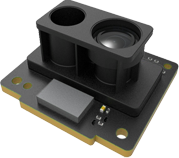
· Laser Emitter: The choice of laser determines the operational wavelength, power, and pulse characteristics. Automotive-grade LiDAR often uses 905nm lasers for their balance of performance and cost-effectiveness. The power output is directly proportional to the potential range, but it must be carefully managed to maintain an eye-safe classification (e.g., LASER 1).
· Lenses and Aperture: The receiving lens's size (aperture) dictates how much of the faint, reflected laser light can be collected. A larger aperture gathers more light, enabling longer detection ranges and better performance on low-reflectivity targets. However, this must be balanced against the physical size constraints of the sensor. The quality of the lenses also impacts the focus and clarity of the signal reaching the detector.
Detector Technology and Electronics
Once the light is collected, the detector and its associated electronics translate the optical signal into digital data. The efficiency of this process is paramount for accuracy.
· Photodetector Type: The sensitivity of the photodetector (e.g., Avalanche Photodiodes or Single-Photon Avalanche Diodes) determines the sensor's ability to detect weak return signals. More sensitive detectors can identify objects at greater distances and those with low reflectivity, contributing significantly to the sensor's maximum effective range.
· Signal Processing Unit: The onboard electronics are responsible for timing the laser pulse's round-trip with picosecond precision. The sophistication of the processing unit, including its algorithms for noise filtering and signal extraction, directly translates to measurement accuracy and resistance to environmental noise like ambient sunlight.
Mechanical Design and System Reliability
The mechanical structure of a LiDAR sensor is not just a housing; it is an integral part of its performance and durability, especially in harsh operational environments.
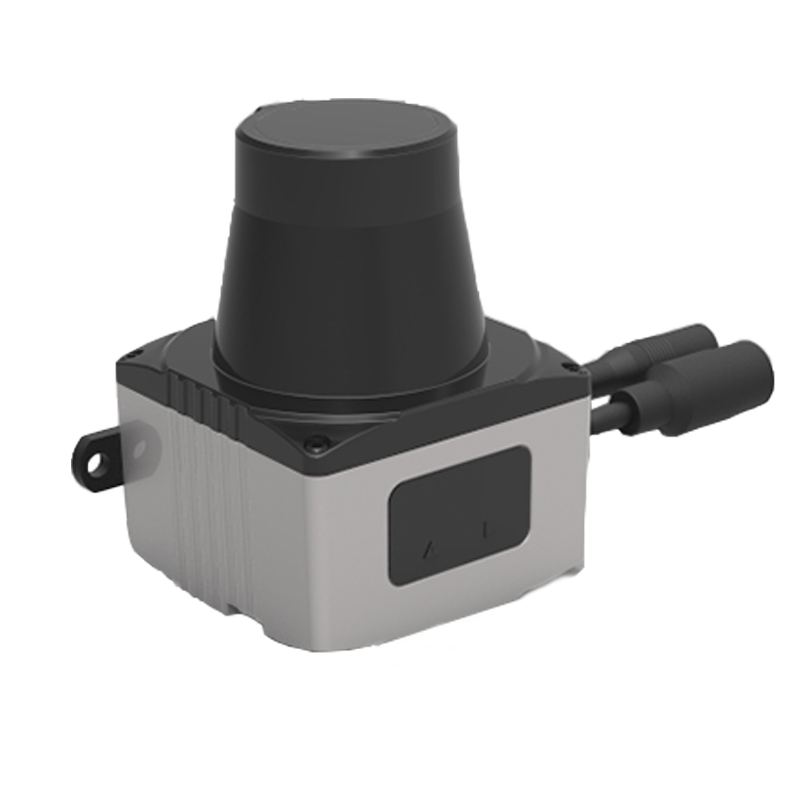
· Scanning Mechanism: In scanning LiDARs, the mechanism that directs the laser beam (e.g., rotating mirrors) determines the field of view and scan pattern. The precision and stability of this mechanism are critical for consistent angular resolution and avoiding data artifacts.
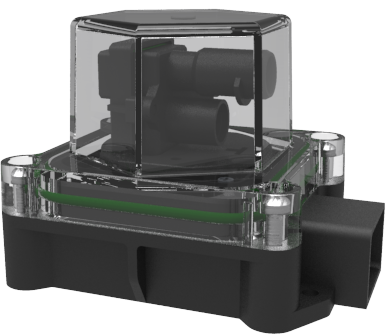
· Thermal Management and Enclosure: LiDAR components are sensitive to temperature fluctuations. A robust hardware design incorporates effective thermal management to ensure consistent performance. Furthermore, the enclosure's design determines its resistance to environmental factors, with ratings like IP67 and IP69K indicating protection against dust and high-pressure water ingress, a necessity for automotive and industrial applications.
Introducing the Benewake AD2-S-X3: Performance Through Superior Design
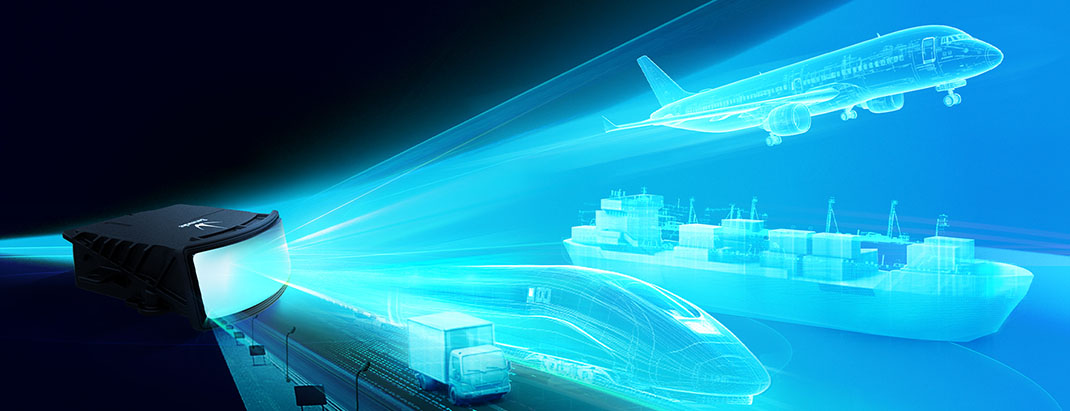
The Benewake AD2-S-X3 is a high-performance 3D LiDAR module where advanced hardware design translates directly into superior, reliable performance. It is engineered from the ground up to meet the stringent requirements of automotive and industrial automation, where performance cannot be compromised. Its robust hardware architecture ensures it delivers high-resolution data consistently, even in challenging real-world conditions.
Key Specifications:
· Detection Range: 200m @10% reflectivity
· Field of View (FOV): 120° (H) x ~51.2° (V)
· Angular Resolution: Up to 0.1° × 0.1° in ROI
· Frame Rate: 10 Hz
· Reliability: Automotive-grade, with IP67/IP69K ingress protection and extensive environmental testing.
· Safety & Security: Meets Functional Safety (ASIL-B) and Cybersecurity (ISO 21434) standards.
The AD2-S-X3's design exemplifies how deliberate engineering choices create a sensor capable of providing the high-quality perception data required for building safer and more intelligent autonomous systems.
Benewake is a LiDAR technology company with a global presence in over 90 countries and hundreds of patents. We provide innovative LiDAR solutions trusted by top 500 enterprises to realize advanced automation. Contact us to learn how the robust hardware design of the AD2-S-X3 can provide a new level of performance for your application.