














Headquarters:3rd Floor, Haiguo Jiaye Sci-Tech Park, Haidian District, Beijing, China

We use cookies to enhance your browsing experience and serve personalized content.
Reject ALL
Accept ALL


2025-12-02
For UAV system integrators, selecting sensor payloads, particularly LiDAR, is critical for mission capability. The deployment method—either on a gimbal or in a fixed position—is a fundamental design choice. This article provides a technical comparison of these two LiDAR configurations, detailing their operational mechanisms, advantages, and ideal use cases to aid in optimizing UAV platforms for applications such as infrastructure inspection and agricultural monitoring.
Fixed LiDAR Systems: The Foundation of Situational Awareness
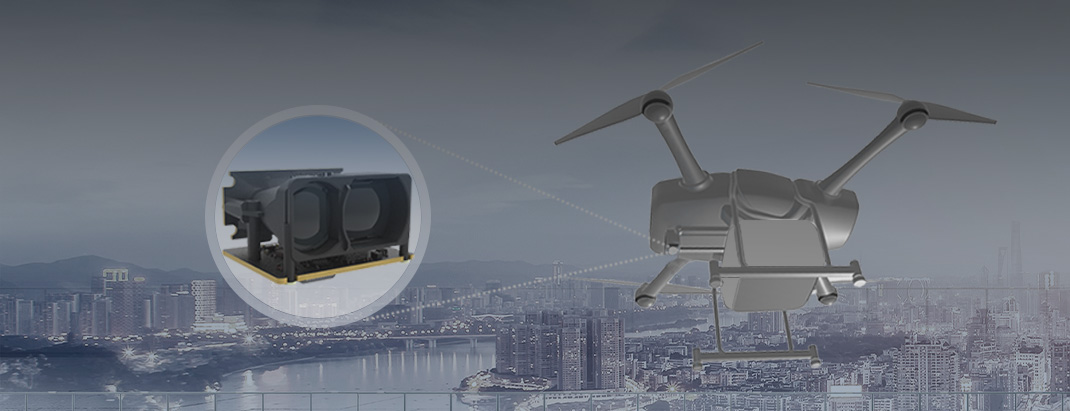
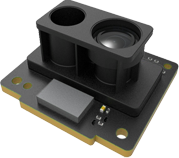
A fixed LiDAR system involves mounting the sensor directly to the UAV's airframe. In this configuration, the LiDAR's field of view (FoV) is static relative to the aircraft's orientation. Its primary function is to provide consistent, reliable data about the environment in a predetermined direction, most commonly for flight stability and basic obstacle avoidance.
How It Works and Key Applications
The LiDAR sensor continuously emits laser pulses in a fixed direction—downward for altitude hold, forward for obstacle detection, or a combination for terrain following. The data collected provides the flight controller with precise measurements essential for stable flight.
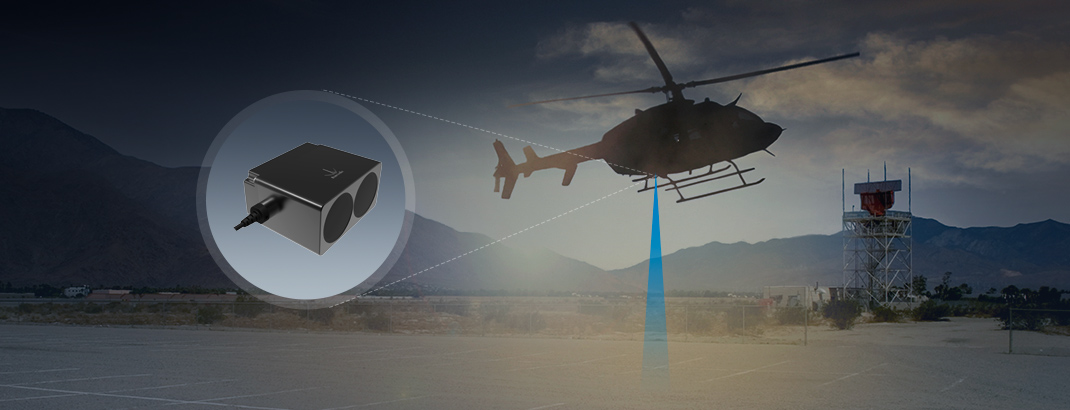
· Terrain Following and Altitude Hold: A downward-facing fixed LiDAR provides highly reliable, absolute distance-to-ground measurements with centimeter-level accuracy. This enables a UAV to maintain a constant altitude over uneven ground, a critical function for applications like precision agriculture and low-altitude surveying.
· Detect and Avoid: A forward-facing fixed LiDAR acts as the primary sensor for collision avoidance, detecting obstacles in the flight path and providing the flight controller with the necessary data to execute evasive maneuvers.
The primary advantage of a fixed system is its simplicity, reliability, and low weight, which helps extend flight endurance.
Gimbal Rangefinding: Dynamic, Focused Intelligence
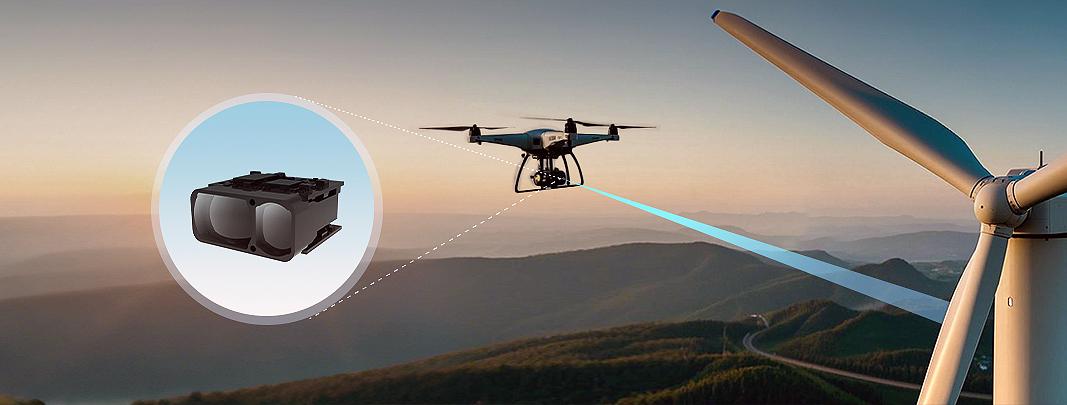
Gimbal rangefinding involves mounting a LiDAR sensor onto a motorized, stabilized gimbal. This mechanical assembly decouples the sensor's orientation from the UAV's, allowing the LiDAR to be aimed independently of the aircraft's movement. This transforms the LiDAR from a static flight-assist tool into a dynamic, mission-specific instrument.
How It Works and Key Applications
The gimbal allows an operator or an autonomous system to direct the LiDAR's laser beam with high precision toward a specific target on the ground or in the air. This capability unlocks a range of advanced applications that require focused tracking and relative positioning.
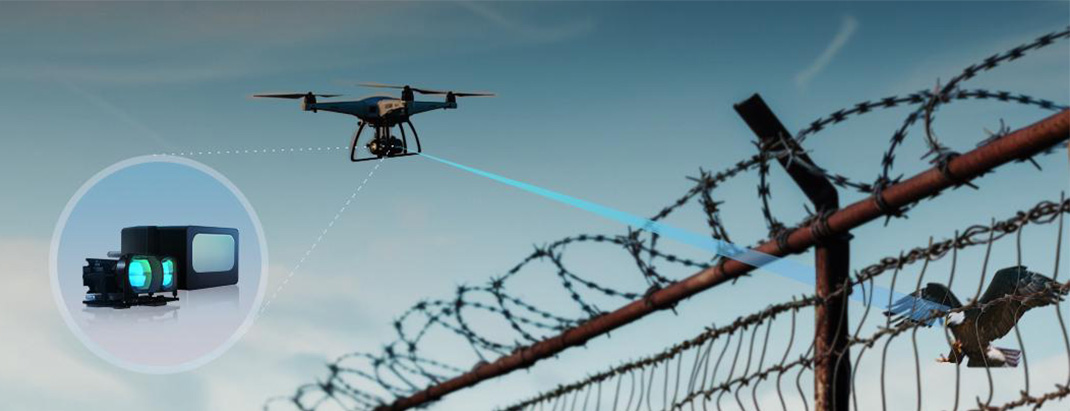
· Intelligent Focused Tracking: Gimbals enable the LiDAR to lock onto and continuously measure the distance to a specific object, even as both the UAV and the target are in motion. This is vital for applications such as power line inspection, where the distance to a specific cable must be maintained, or for tracking vehicles.
· Pinpoint Ranging and Object Sizing: By directing the narrow beam of a LiDAR, a gimbal system can provide real-time distance measurements to very small targets from a significant standoff distance. This enables detailed inspection and pinpoint data acquisition without requiring the UAV to perform complex maneuvers.
The main advantage of a gimbal system is its operational flexibility, allowing a single sensor to perform multiple, mission-specific tasks.
Choosing the Right System
The decision between a fixed and a gimbaled LiDAR is not about which is superior, but which is appropriate for the mission. Fixed systems are the bedrock of safe and stable flight, providing essential data for core functions like terrain following and basic obstacle avoidance. Gimbal systems build upon this foundation, adding a layer of intelligent, dynamic targeting for advanced inspection, tracking, and data acquisition missions. In many advanced UAV platforms, both systems are used concurrently to achieve maximum capability and safety.
Benewake is a global LiDAR technology company with hundreds of patents and a business presence in over 90 countries. Our innovative LiDAR sensors for drones are engineered to meet the demanding requirements of the UAV industry, providing the high-performance data needed for everything from stable flight to intelligent automation. Our miniaturized LiDAR sensors, weighing as little as 5g and capable of passing DO-160G certification, empower system integrators to build safer, more capable, and longer-flying UAVs.
Contact our team to discover how Benewake’s advanced LiDAR solutions can provide the reliable performance and precision your UAV application requires.